

In a move that promises to reshape the landscape of multi-tenant cloud applications, Amazon Web Services (AWS) has announced the launch of AWS Lambda MicroVMs. This new serverless compute primitive is designed to solve a persistent architectural dilemma: how to run untrusted, user-generated, or AI-authored code in a highly isolated environment without sacrificing performance or incurring the overhead of traditional virtual machine management.
By leveraging the battle-tested Firecracker virtualization technology—the same engine that powers the trillions of monthly invocations of standard AWS Lambda functions—AWS is providing developers with a unique blend of virtual machine-level isolation, near-instantaneous startup times, and persistent stateful execution.
The Evolution of the Serverless Paradigm
For years, the industry has relied on a tiered approach to compute. On one end, virtual machines (VMs) have provided robust isolation but were plagued by slow "cold start" times. On the other, containers offered agility but required complex kernel hardening to ensure security in multi-tenant environments. Finally, Functions-as-a-Service (FaaS) revolutionized event-driven computing but struggled with long-running, stateful sessions.
Lambda MicroVMs fill this "missing middle." They are engineered specifically for applications where every end-user or session requires its own dedicated execution sandbox. Whether it is an AI coding assistant, a collaborative data science notebook, a browser-based game server, or a real-time security vulnerability scanner, the need for a persistent, secure, and ephemeral environment has never been more acute.
The Problem with the Current Status Quo
Engineering teams today often face a "difficult choice" when building modern applications. If they choose standard containers, they must dedicate significant engineering resources to hardening their infrastructure against potential cross-tenant attacks. If they opt for VMs, they sacrifice the low-latency user experience required for interactive applications.

"Lambda MicroVMs is purpose-built for exactly this gap," AWS stated in its release. By providing a dedicated MicroVM for a single session, developers no longer need to manage complex virtualization stacks or trade away security for speed.
A Chronology of the Innovation
The roots of this launch can be traced back to the open-sourcing of Firecracker in 2018. Designed for speed and security, Firecracker enabled AWS to run lightweight, KVM-based virtual machines with the agility of containers.
The Development Arc:
- 2018: AWS releases Firecracker, establishing the foundation for secure, lightweight virtualization.
- 2018–2025: Firecracker matures, powering trillions of Lambda invocations, gaining industry-wide adoption for its minimal overhead and robust security boundary.
- Mid-2026: AWS identifies the growing demand for stateful, long-running serverless environments, particularly driven by the explosion of generative AI and interactive coding platforms.
- June 2026: AWS announces the general availability of Lambda MicroVMs, integrating the Firecracker stack into a new, user-facing resource within the Lambda ecosystem.
Technical Deep Dive: How Lambda MicroVMs Work
At the core of the service is a three-pronged technical architecture that differentiates it from traditional Lambda functions.
1. Virtual Machine Level Isolation
Unlike standard containers that share a host kernel, each Lambda MicroVM session runs in its own dedicated, firewalled environment. This ensures that even if an end-user provides malicious code, the "blast radius" is limited to that specific, isolated instance.
2. The "Snapshot-and-Resume" Lifecycle
The innovation here is the "image-then-launch" model. Developers package their applications using Dockerfiles, which are then built and converted into a Firecracker snapshot. This snapshot contains the exact memory and disk state of the application after initialization. When a new session starts, AWS does not "boot" the OS; it "resumes" the snapshot. This allows for multi-gigabyte environments to be ready for traffic in a fraction of a second.

3. Stateful Persistence
Standard Lambda functions are stateless and ephemeral. In contrast, Lambda MicroVMs maintain memory and disk state for the duration of a session. If a user walks away, the environment can be suspended—effectively pausing the process—and resumed exactly where it left off when the user returns.
Implementing the Solution: A Developer’s Perspective
The workflow for developers is intentionally streamlined to fit into existing CI/CD pipelines.
The Build Process
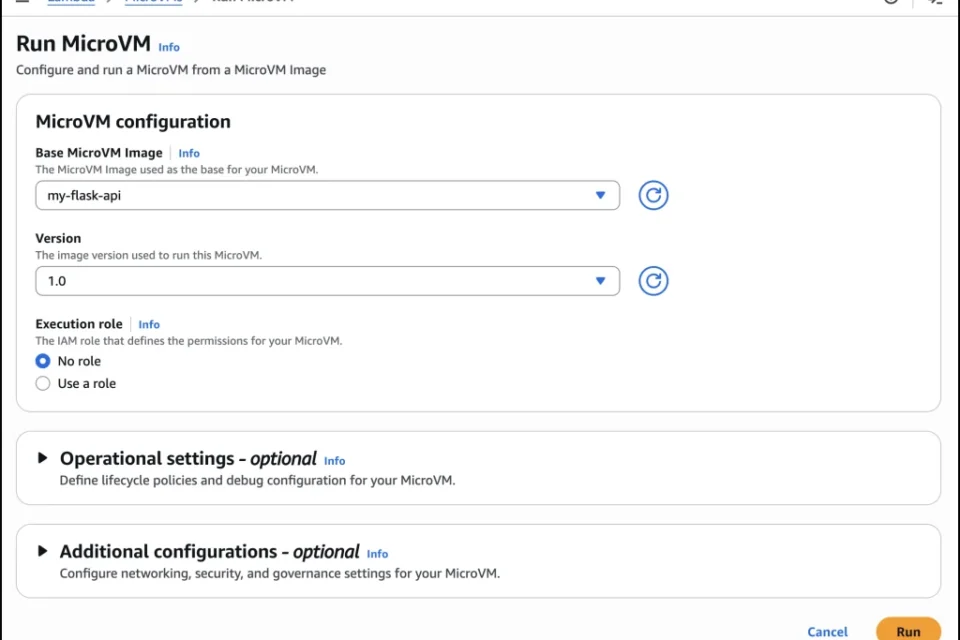
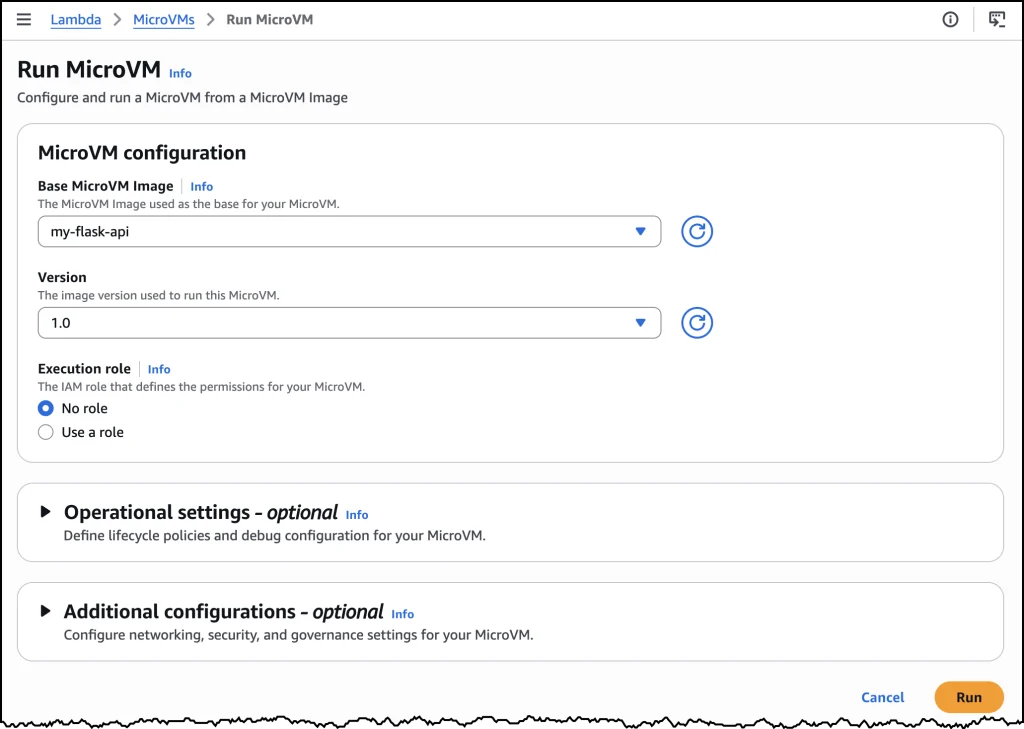
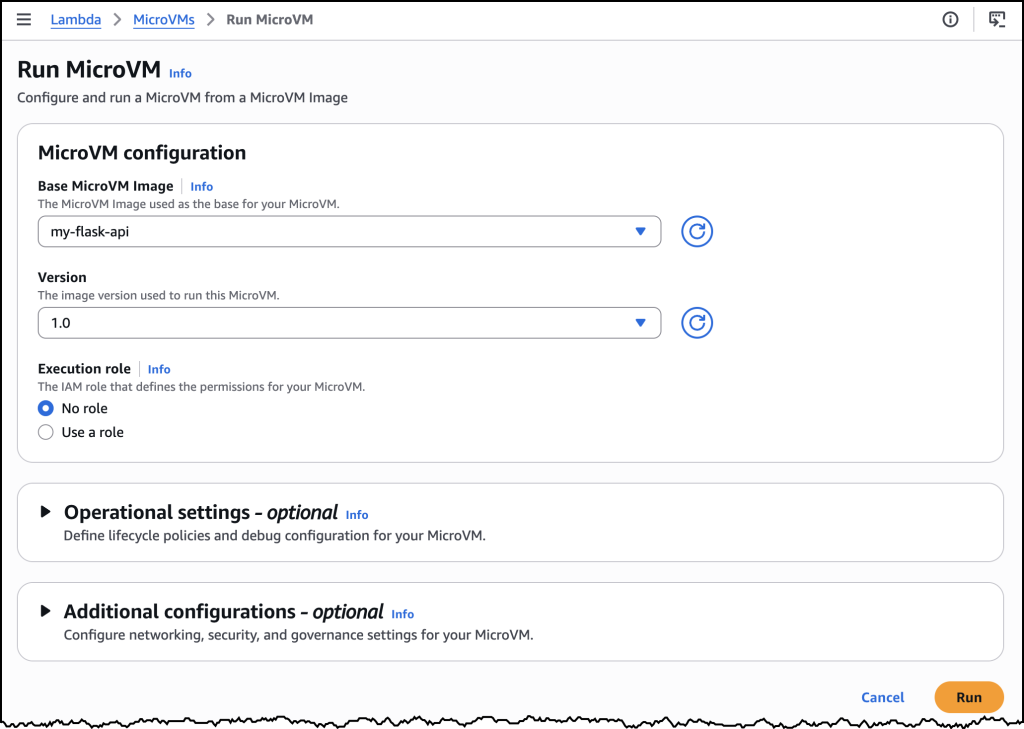
Developers define their environment using a Dockerfile. For example, a Flask web application can be containerized and sent to an Amazon S3 bucket. Using the aws lambda-microvms create-microvm-image command, the service builds the image, initializes the environment, and captures the state.
Managing Lifecycle and Traffic
The runtime experience is governed by an "idle policy." Developers can configure how long a session stays active before it is suspended, optimizing for both responsiveness and cost.
- Idle Policy:
maxIdleDurationSecondsandsuspendedDurationSecondsallow for automated management of compute resources. - Networking: Networking is abstracted away, providing developers with a direct endpoint URL, removing the need for complex VPC or load balancer configurations.
Supporting Data and Scaling
The service is launching with impressive specs, catering to high-performance workloads:

- Architecture: ARM64-based for efficiency.
- Resource Ceiling: Up to 16 vCPUs and 32 GB of memory per MicroVM.
- Storage: 32 GB of disk space.
- Regional Availability: Initially available in US East (N. Virginia, Ohio), US West (Oregon), Europe (Ireland), and Asia Pacific (Tokyo).
These specifications suggest that AWS is targeting heavy-duty compute tasks, such as running LLM inference modules or complex data analysis libraries that were previously too heavy for standard Lambda runtimes.
Official Responses and Strategic Implications
Industry analysts view this as a strategic pivot to capture the "AI Agent" market. As applications transition from simple request-response interactions to long-running, autonomous agents that "think" and "code" on behalf of users, the requirement for a persistent, secure compute state becomes mandatory.
"We are moving from a world of stateless microservices to a world of stateful agents," noted a lead cloud architect at a major SaaS firm. "Lambda MicroVMs allow us to give every user their own ‘private server’ that exists only when they need it, at a fraction of the cost of a permanently provisioned EC2 instance."
The Broader Implications
The launch of Lambda MicroVMs has several profound implications for the software development ecosystem:
1. The Democratization of Secure Sandboxing
Startups that lack the infrastructure budget to build complex security sandboxes can now offer enterprise-grade isolated environments. This will likely trigger a wave of innovation in collaborative tools, such as web-based IDEs and shared research environments.
2. Shifting Costs to Usage
By enabling "suspend-on-idle," AWS is encouraging a shift toward a more granular billing model. Developers are no longer paying for the idle time of a dedicated VM; they are only paying for the compute power used during active, productive sessions.
3. A Complementary Ecosystem
AWS has been careful to frame this as an evolution, not a replacement. Lambda Functions remain the gold standard for high-throughput, event-driven web APIs, while MicroVMs handle the complex, stateful, and untrusted execution. Together, they form a comprehensive toolkit that covers the entire spectrum of cloud compute requirements.
Conclusion
AWS Lambda MicroVMs represent a maturation of the serverless philosophy. By moving beyond the stateless, event-driven paradigm into the realm of stateful, isolated compute, AWS is once again lowering the barrier to entry for complex application architectures. As developers begin to integrate this technology into their stacks, we are likely to see a new generation of cloud-native applications that are more secure, more interactive, and more cost-efficient than ever before.
For teams currently struggling with the "isolation versus performance" trade-off, this release is not just a feature update—it is the solution to a foundational architectural hurdle.
